Luther Roscovitz
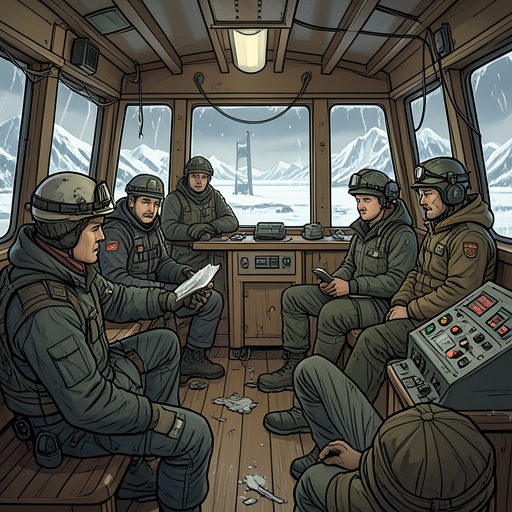
The SwarmLuther Roscovitz is a US Navy commander whose professional life joins military commitment to an unusually inquisitive approach to the world beneath the sea. Put in charge of the USS Independence’s dive station as it prepared for the Greenland Sea expedition, he helped equip and train the mission’s crew for deep-water operations. His conviction that people might eventually have to confront the threat underwater rather than leave every decision to machines becomes a defining principle—and, during the attack on the well deck, his expertise cannot protect him from a system failure and sudden violence.
Identity and Naval Career
Roscovitz had devoted his life to the US Navy and had no desire to leave it. He chose submarines because he liked being underwater, advancing until he became a commander. His commitment to service, loyalty, and patriotism did not make him a mindless conformist: the account emphasizes that curiosity was among his most important qualities, and that rote drilling was not his nature.
His curiosity took a practical form. Believing that submarine commanders knew too little about the world they inhabited, he set about educating himself. He did not become a biologist, but his inquiring mind caught the attention of the Navy’s technological division, which wanted people who could combine a soldier’s loyalty with the intellectual agility to take executive roles in research. That unusual mixture explains why Roscovitz is entrusted not merely with command duties but with choices about the expedition’s scientific and technical equipment.
Preparing the Dive Station
Once the USS Independence was assigned to the Greenland Sea expedition, Roscovitz was charged with finding it a state-of-the-art dive station. The mission was treated as an undertaking on which humanity’s hopes might depend, and he was authorized to buy whatever seemed useful, at any price, or commission equipment that did not yet exist, provided it could be built before departure. He drew up a wish list and brought substantial cash to the firm he approached, with one demand: the submersible had to be built faster than any known record. The money helped secure the deal.
Roscovitz’s most consequential choice was to insist on carrying manned submersibles. Remotely operated vehicles such as Victor had clear advantages, and autonomous vehicles could work without a connecting cable while using high-resolution cameras and mechanical arms. The danger to divers was already plain; people had been attacked or killed, and even entering the water had become hazardous. Roscovitz understood those objections but rejected the conclusion that machines alone should do the work. In his view, a machine could perform tasks and deliver force, but it could not necessarily make the decisions demanded of a person confronting an enemy. He expected that the mission might reach a point when its personnel would have to go down and deal with the problem themselves.
His command responsibilities also extended to preparation of the people who would use the equipment. The Navy and crew had received an induction in Norfolk, Virginia, but Roscovitz was not satisfied that the scientists could simply rely on the military team. At the jetty he assembled them in thermally insulating neoprene suits and began teaching them deep-sea flying and fighting. Most of the SEALs were already at home in the water; he nevertheless considered it possible that circumstances would require civilians to play a decisive role. Training them was therefore part of his effort to make the expedition capable of acting under pressure, not merely observing from a safe distance.
Commander of the Dive Station
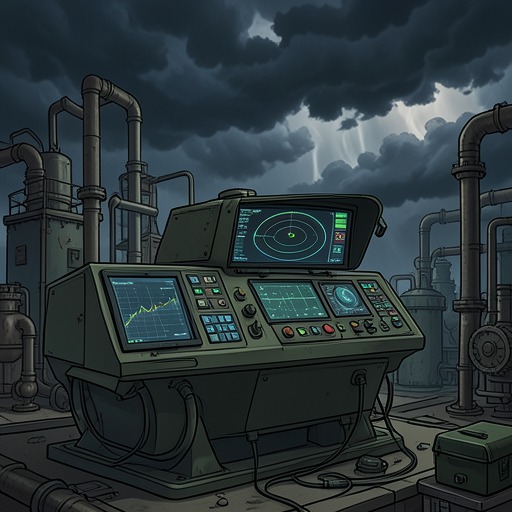
Aboard the USS Independence, Roscovitz was in charge of the dive station. Its console stood beside the pool and controlled the hatches, the submersibles, and the pump used to fill the basin. The well deck’s sluice connected the pool to the ocean through glass flaps and a second set of steel doors, separated by a short shaft. The gates were designed never to open simultaneously; sensors checked the water for impurities and toxins before a returning submersible or dolphin could be released into the basin. Roscovitz’s station placed him at the operational center of this carefully controlled passage between ship and sea.
That system depended on people being able to see what was happening as well as on the interlocks and sensors functioning. When a damaged Deepflight remained tethered above the sluice, Roscovitz objected to its position, particularly with dolphins moving in and out. Browning, the head technician, maintained that it was not in the way and would be lifted once repairs were complete. From the controls, however, the floating craft blocked Roscovitz’s direct view of the sluice. He had to rely on the screens, and his frustration reflects the hurried, imperfect outfitting of the ship: equipment meant to enable the mission had become an obstruction at a critical point.
The Well-Deck Attack
During the operation to bring the dolphins through the sluice, Roscovitz switched on the audio recording used to summon them and watched the scientists enter the illuminated basin. The dolphins approached the glass hatch; once the steel doors opened, the animals passed into the shaft. After the last of the visible dolphins had entered, the steel plates closed, sensors tested the water, and the green all-clear allowed the glass flaps to open. The procedure appeared to be working, but the missing animals and the blocked view made the situation difficult to assess from the console.
An orca then smashed through the hatch. The jetty groaned under the impact, a wave lifted the Deepflight, and Browning lost her balance. As the animal rammed the submersible, it spun into the air and tore free of its chain. Browning was flung onto the control panel; one of her boots struck Roscovitz in the chest and sent him reeling against the bulkhead, taking Peak with him. The Deepflight rose, filled with water, and sank. The broken chain swung back like a whip: Roscovitz tried to duck, but the metal struck his temples and curled around his neck.
The scene’s reversal is especially stark beside his earlier argument for manned operations. Roscovitz had maintained that people would eventually have to descend and act for themselves; now, in the well deck, the machinery and procedures he commanded could not keep the attack at a distance. His station’s blocked sightline, the loose chain, and the force of the orca’s strike convert a technical breakdown into immediate physical peril. The episode does not present his expertise as useless, but it shows its limits when the environment and the attack overwhelm the engineered safeguards.
Final Appearance and Narrative Significance
After the attack, Rubin surfaced near Roscovitz’s legs. The commander stared down at him through bulging eyes, hanging above the water in an image compared to a man on a gallows; a terrible gurgling sound came from his lips. The orca’s fin was almost upon Rubin. In the supplied account, Roscovitz’s fate is not explicitly confirmed, but this is his last appearance and leaves him in acute danger, incapacitated and caught within the same lethal assault as the scientists and dolphins.
Roscovitz’s role gives the expedition’s technological ambition a human face. He is neither simply a soldier nor a scientist: his curiosity wins him a place in research planning, while his military judgment shapes the choice to train civilians and deploy manned craft. His insistence on human agency meets a cruel limit in the well deck, where command, observation, and procedure all falter at once. The contrast does not erase his foresight; instead, it exposes the precariousness of the boundary he is charged with managing, between a controlled shipboard system and the ocean beyond it.